
Five years ago if you’d said that data storage prices would double year-on-year you’d have been laughed out of the room. But that’s exactly what’s happening now.
OpenAI and other AI companies have been hoarding RAM and storage to fuel their AI model training demands. The result: we all get to experience global shortages of critical computing hardware, causing price spikes and widespread uncertainty.
It’s difficult to know the full scale of what’s happening and how long it will last. While this isn’t the first time we’ve seen rising hardware prices, the current trajectory is unique. But we’ve lived through shortages before, so here at SiteHost we're relying on our experience and doing what we can to stay one step ahead.
It’s not just RAM anymore
Unless you’ve been off the grid for the last 6 months, you’ll almost certainly have seen news and uproar about global RAM shortages. The situation was spearheaded by Open AI, after they made deals with the biggest RAM suppliers to secure 40% of the world’s global memory production capacity. Since then, RAM has only gotten harder to buy. As it stands, it seems likely memory will only get more prohibitively expensive and inaccessible for consumers.
But RAM isn’t the only hardware caught up in this mess. SSD prices were the first to follow RAM’s price trajectory. AI hardware like GPUs require a specialised type of memory called HBM (high-bandwidth memory). It's made on the same production lines as conventional RAM and SSD components. Manufacturers are prioritising it because it's far more profitable than DRAM or NAND, meaning higher prices across the board.
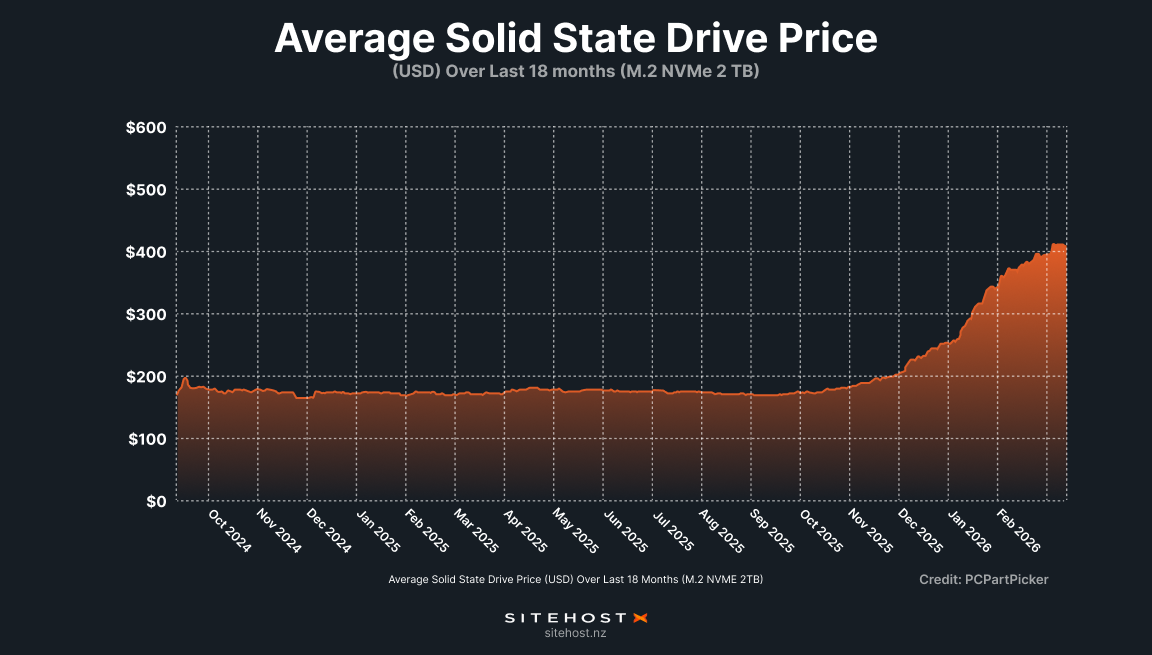 Not long after RAM prices started going up, SSD prices followed suit.
But now it seems HDDs are following suit, which is surprising given that HDD storage had gotten 20× cheaper in the previous 15 years.
2011: A natural disaster and a temporary price spike
Disruptions have happened before. We’ve been around long enough to have seen supply chains falter more than once.
Back in 2011, massive flooding in Thailand shook up the world's main supply of HDDs. Before those floods, 40% of the world’s HDDs were produced in Thailand. One facility in particular was producing ¼ of the world’s supply of HDD sliders (a tiny but vital component).
Floodwaters damaged that factory, halting the slider manufacturing. As a result we experienced global supply chain disruptions, and the prices of all sizes of HDDs jumped up in the months that followed.
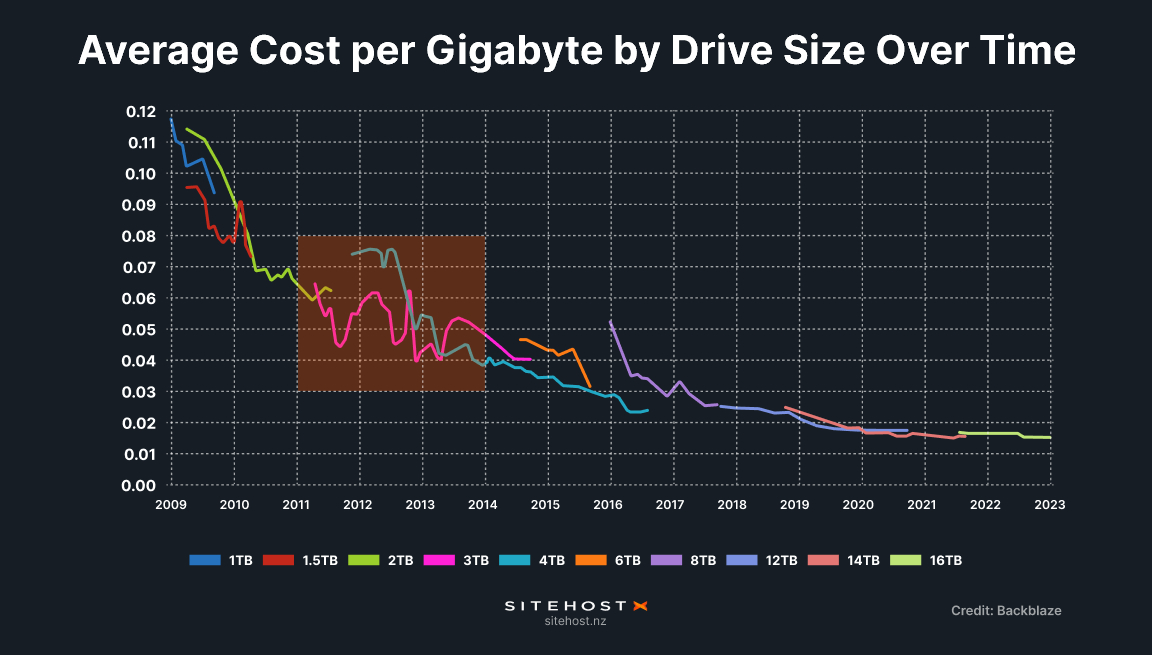 There's a clear downward trend over time, but flooding in Thailand caused big spikes in 2011/12.
The point here is that external factors have caused sudden price rises in the past. In the case of Thailand, by the end of 2012 (one year after the floods) factories were rebuilt and repaired. Supply was higher than ever, but the shortages continued to affect the HDD market through to 2013, where things started to get back to normal. It’s a case of prices spiking and eventually returning back to normal after supply caught up with the demand.
But that’s not always the case.
2020: A pandemic creates a new baseline
In more recent memory, COVID-19 created a global chip shortage in 2020. The pandemic forced semiconductor factories across Asia to close. At the same time, people across the world were made to work and keep themselves entertained at home. Lots of people began buying gaming PCs to keep themselves occupied, or upgrading their tech for a home work setup. Add in the impacts of cryptocurrency mining on GPU demand and a China-US trade war, and a perfect storm was created. Demand for chips, particularly GPUs, rose at the same time as manufacturing was forced to slow down.
By 2023, once lockdowns were all cleared and crypto mining had eased off, GPU pricing levels didn’t return to pre-2020 levels. Instead, GPUs settled at a new higher baseline price. This was different to post-flood HDD prices, which did eventually revert to their pre-crisis trajectory. Inflation, rising manufacturing costs and heightened AI development have kept GPU costs high to this day.
Aggravating factors at play
Unlike the case of the Thailand floods causing HDD shortages, the current wave of hardware shortages aren’t caused by an isolated incident. Our present situation seems more similar to the COVID chip situation, where a variety of factors contributed.
The very finite number of companies manufacturing RAM is definitely one aggravating factor; Samsung, SK Hynix and Micron control 90% of the global RAM market.
While there’s excitement for new semiconductor fabrication plants being built, these facilities are incomprehensibly complex and take years to build. It’ll be even longer before they’re manufacturing enough RAM to alleviate market demands. There really isn’t much room for RAM production to scale upwards anytime soon.
We can’t see the future
Consider a hypothetical scenario where an “AI bubble collapse” does happen and RAM and SSD demand calms down in the near future. That doesn’t necessarily mean component prices will decrease.
If demand falls, classic economic theory suggests prices should drop. But once a supplier of RAM sees the market bear a higher price, they can just as easily be tempted to keep that inflated price—or at least the margin built into it—in place as they release and price new models. We saw something like this with GPUs, as crypto mining dropped off shortly before AI took its place demand wise.
So, what are buyers doing?
As a result, companies whose operations rely on RAM and storage are stockpiling storage and RAM when and where they can, us included.
Everyone is buying up stock as soon as it’s available, making parts a lot harder to come by. With hardware in short supply, it’s imperative to stock up now, rather than be stuck empty-handed or paying unguessable prices later.
Look at how the biggest tech companies with large purchasing power have reacted; Lenovo said they have 50% more RAM in their inventory than they usually do. But Lenovo is the biggest PC manufacturer in the world, and boasts an economy of scale few can match.
While this isn’t the first time we’ve seen spiking hardware prices, we’ve never seen costs escalate at this current trajectory.
Smaller, yet still large, companies with less sway over manufacturers are left more exposed by the shortages. For instance, Valve recently postponed their Steam Machine hardware release to an undetermined date, citing RAM and storage shortages as the cause. Valve’s hardware requirements are tied to fixed component specifications, and reliant on mass orders. Unlike Lenovo, they’re too small to demand priority attention from manufacturers. They’re stuck in an awkward spot, where it’s too late to change course or find a new supply source.
What is SiteHost doing?
At SiteHost we’re able to operate from a nimble position. Sure, we can't throw our weight around like Lenovo, but unlike Valve we have the advantage of not needing millions of RAM sticks all of the exact same specification.
Our position affords us supply chain flexibility. Acquiring new NVMe SSDs isn’t as easy as going down the road to the closest retailer anymore. Instead we’ve been sourcing components from new places, like making large shipments from overseas.
Like the biggest tech companies, we’ve been stocking up our inventory in preparation. For all major upgrades we have planned throughout the year, we've been buying the parts now rather than leaving it up to chance later in the year.
Where does that leave us?
The shortages have already caused big change in the industry. Every company’s approach to hardware has changed, us included.
We’ve seen spikes in hardware prices before and learned from them, like with HDDs in 2011 and chip shortages in 2020. We’re doing what we can to stay one step ahead and have taken measures to ensure our inventory is well-stocked. Our size affords us the room to be more nimble with our supply chain. We’re not reliant on sourcing quantities of storage or memory that is simply no longer in circulation.
It’s still hard to say how long these market conditions will last. Maybe they’ll relax by the end of the year. Maybe in 12 months the shortages will be even more pronounced. We’ve taken the approach that we’d rather have extra supply on hand now rather than be left empty-handed.
You don’t want your plans to be interrupted by hardware shortages. To keep your websites running on servers fitted out with up-to-date infrastructure, come and talk to us.